OpenGL ES 2.0 Programming Guide

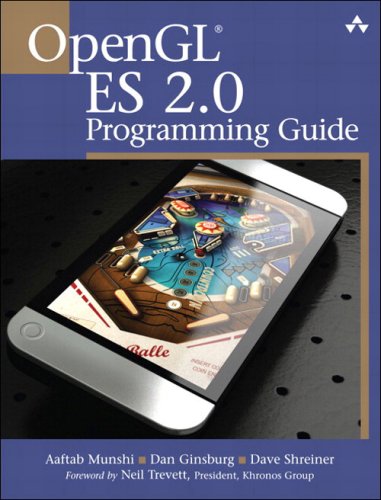
OpenGL ES 2.0 Programming Guide 's just that the product is on sale now. So you can decide more easily. And OpenGL ES 2.0 Programming Guide has a limited amount of extra time. OpenGL ES 2.0 Programming Guide is one of quality products. OpenGL ES 2.0 Programming Guide is made from premium materials. Compared to products with similar applications. This product is much better. And not with I ordered from the Internet. To make it easier for the owners. Once you have activated, you will know it meets your needs as much. If you want to see detail of OpenGL ES 2.0 Programming Guide . Please click on the Get Discount Price Here.

OpenGL ES 2.0 Programming Guide Overview
This is the eBook version of the printed book.
OpenGL ES 2.0 is the industry’s leading software interface and graphics library for rendering sophisticated 3D graphics on handheld and embedded devices. With OpenGL ES 2.0, the full programmability of shaders is now available on small and portable devices—including cell phones, PDAs, consoles, appliances, and vehicles. However, OpenGL ES differs significantly from OpenGL. Graphics programmers and mobile developers have had very little information about it—until now.In the OpenGL® ES 2.0 Programming Guide, three leading authorities on the Open GL ES 2.0 interface—including the specification’s editor—provide start-to-finish guidance for maximizing the interface’s value in a wide range of high-performance applications. The authors cover the entire API, including Khronos-ratified extensions. Using detailed C-based code examples, they demonstrate how to set up and program every aspect of the graphics pipeline. You’ll move from introductory techniques all the way to advanced per-pixel lighting, particle systems, and performance optimization.
Coverage includes:
- Shaders in depth: creating shader objects, compiling shaders, checking for compile errors, attaching shader objects to program objects, and linking final program objects
- The OpenGL ES Shading Language: variables, types, constructors, structures, arrays, attributes, uniforms, varyings, precision qualifiers, and invariance
- Inputting geometry into the graphics pipeline, and assembling geometry into primitives
- Vertex shaders, their special variables, and their use in per-vertex lighting, skinning, and other applications
- Using fragment shaders—including examples of multitexturing, fog, alpha test, and user clip planes
- Fragment operations: scissor test, stencil test, depth test, multisampling, blending, and dithering
- Advanced rendering: per-pixel lighting with normal maps, environment mapping, particle systems, image post-processing, and projective texturing
- Real-world programming challenges: platform diversity, C++ portability, OpenKODE, and platform-specific shader binaries
OpenGL ES 2.0 Programming Guide Specifications
This is the eBook version of the printed book.
OpenGL ES 2.0 is the industry’s leading software interface and graphics library for rendering sophisticated 3D graphics on handheld and embedded devices. With OpenGL ES 2.0, the full programmability of shaders is now available on small and portable devices—including cell phones, PDAs, consoles, appliances, and vehicles. However, OpenGL ES differs significantly from OpenGL. Graphics programmers and mobile developers have had very little information about it—until now.In the OpenGL® ES 2.0 Programming Guide, three leading authorities on the Open GL ES 2.0 interface—including the specification’s editor—provide start-to-finish guidance for maximizing the interface’s value in a wide range of high-performance applications. The authors cover the entire API, including Khronos-ratified extensions. Using detailed C-based code examples, they demonstrate how to set up and program every aspect of the graphics pipeline. You’ll move from introductory techniques all the way to advanced per-pixel lighting, particle systems, and performance optimization.
Coverage includes:
- Shaders in depth: creating shader objects, compiling shaders, checking for compile errors, attaching shader objects to program objects, and linking final program objects
- The OpenGL ES Shading Language: variables, types, constructors, structures, arrays, attributes, uniforms, varyings, precision qualifiers, and invariance
- Inputting geometry into the graphics pipeline, and assembling geometry into primitives
- Vertex shaders, their special variables, and their use in per-vertex lighting, skinning, and other applications
- Using fragment shaders—including examples of multitexturing, fog, alpha test, and user clip planes
- Fragment operations: scissor test, stencil test, depth test, multisampling, blending, and dithering
- Advanced rendering: per-pixel lighting with normal maps, environment mapping, particle systems, image post-processing, and projective texturing
- Real-world programming challenges: platform diversity, C++ portability, OpenKODE, and platform-specific shader binaries
1. This page is a participant in the Amazon Services LLC Associates Program, an affiliate advertising program designed to provide a means for sites to earn advertising fees by advertising and linking to amazon.com
2. Amazon, the Amazon logo, Endless, and the Endless logo are trademarks of Amazon.com, Inc. or its affiliates.
3. CERTAIN CONTENT THAT APPEARS ON THIS SITE COMES FROM AMAZON SERVICES LLC. THIS CONTENT IS PROVIDED AS IS AND IS SUBJECT TO CHANGE OR REMOVAL AT ANY TIME.
